The buyer question
We need to hire operations, maintenance or supply-chain leadership for a logistics operation in or around Hasselt; what does the verified record say about this market, and how should a mandate here be structured?
What the public record shows
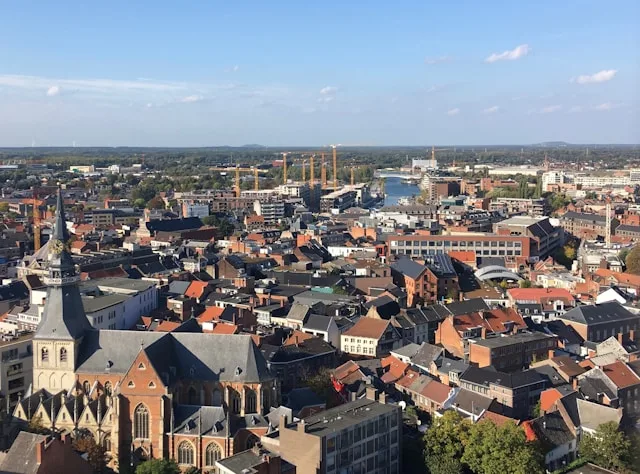
Hasselt's position is a corridor position, and the record states it precisely. The E313 runs approximately 112 kilometres from Antwerp to Liège, and Hasselt is the other major city it serves. The E314, running from Leuven toward Genk and Aachen, crosses the E313 at Knooppunt Lummen, a turbine interchange just west of the city, whose section toward Genk opened in 1971. The city also sits on the Albert Canal. What the record does not support is the "Golden Triangle" framing this market sometimes gets: in Belgian logistics practice that label belongs to the Brussels-Antwerp-Ghent core, the market where valuers, logistics investors and 3PL operators use the term, and Hasselt sits outside it, to the east. That position is not a weakness; it is the market's defining condition. A Hasselt operation does not compete for talent inside the Flemish core. It competes with the documented Genk-side sites on its own doorstep and with employers across the Dutch and German borders.
The documented weight of this corridor sits on the Genk side. Port of Limburg opened its container terminal on the Albert Canal - on the redeveloped former Ford site, with direct E313 and E314 access - in March 2025, as a joint venture of Medlog, Group Machiels and H.Essers. Genk Green Logistics is redeveloping that former Ford plant into a logistics and semi-industrial complex of roughly 250,000 square metres, with its first new logistics building delivered in December 2020. H.Essers is headquartered in Genk and opened a dedicated pharmaceutical cross-dock there in 2022, in what the company calls Belgium's "Pharma Valley". Katoen Natie runs its Limburg platform at Genk-Zuid, and Gosselin operates a container terminal there with 51,000 square metres of bonded warehousing. For a hiring organisation based in Hasselt, these are the named, verifiable competitors for the same corridor talent pool - minutes down the E314, not a hypothesis.
On the Hasselt side, the dominant documented fact is a closure. Coca-Cola's Hasselt site was a distribution depot, not a bottling plant; in January 2019 the company announced the closure of its Hasselt and Heppignies depots, with the work moving to Gent and Antwerp and the unions putting the plan at 132 jobs, and the Hasselt site shut in 2021 after industrial action that ran from the pickets of January 2019 to the December 2019 blockades of all five Belgian sites. Coca-Cola Europacific Partners' current location list still names Hasselt among its distribution-only sites, alongside manufacturing and distribution sites in Antwerp, Chaudfontaine and Gent. No public record places a DHL Supply Chain e-commerce hub at Kiewit; DHL's automated e-commerce flagship in "Limburg" stands at Beringe, on the Dutch side of the border.
The labour-market frame is documented at the Flemish level. VDAB's 2026 list runs to 227 bottleneck occupations, and the agency attributes them to three causes: too few candidates available, qualitative mismatch - including poor alignment between education and the workplace - and specific working conditions. The 2025 list, published on 31 January 2025 under the headline that structural scarcity persists, ran to 251 occupations. The employer view runs the same way. Voka Limburg's Toekomstindicator 2026, published on 15 September 2026, reports that the Limburg economy is losing speed on three crucial engines of future growth and that the first figures for 2026 show no turn; the chamber targets at least 2 per cent structural growth per year - one extra growth point is worth an estimated 3.7 billion euros against 2035 - and names smart infrastructure, digitalisation and strong multimodal connections as the way to build Limburg out further as a logistics hub. Voka Limburg also filed a 75-point plan with the Flemish government (VRT NWS, 14 September 2026).
Two regulatory frames matter to a mandate here, and both are on the record. Flanders' energy-performance certificate regime for non-residential buildings tightened in steps - mandatory at transfer or lease from 2023, permanent for buildings of 1,000 square metres or more from 1 January 2025, and for every large non-residential unit from 1 January 2026 - while warehouses and industrial buildings are exempt, and a minimum label E is required for large units only from 2030. Belgian private-sector wages adjust automatically when the smoothed health index crosses the pivot index: the white-collar adjustment of 1 January 2025 was 3.58 per cent, and estimates for 1 January 2026 run near 2.19 per cent. Across the border, the Netherlands' expat ruling still exempts 30 per cent of salary from Dutch tax in 2025 and 2026, steps down to a 27 per cent facility on 1 January 2027 for arrangements that began from 2024 onward, and applies in 2026 subject to a salary cap of €262,000. For cross-border technical profiles, that package arithmetic is a documented part of the competition.
What the verified record does not contain is any Hasselt-specific vacancy-duration, salary-band, automation-adoption, land-supply or permit-duration series. The vacancy series that does exist covers the core corridor - JLL's Belgian real estate report for the first half of 2026 puts logistics vacancy at 3.8 per cent on the Brussels-Antwerp axis - not Hasselt. The structure of this market is verifiable; its arithmetic must be argued from structure, not quoted.
What changes in this market
A Hasselt logistics mandate is a corridor mandate at the edge of the Flemish core, in a labour market the public employment service describes as structurally scarce with an education-alignment problem at its root. The roles that keep automated and multimodal operations running - maintenance and mechatronics profiles, terminal and transport supervisors, pharma-grade operations leads - are precisely the roles whose alternatives are documented: the Genk-side terminals and campuses minutes to the east, and Dutch employers whose expat ruling runs at 30 per cent through 2026. The two sides of the border move wages on different mechanisms - automatic indexation in Belgium, negotiated settlements plus the ruling in the Netherlands - so a gross-to-gross comparison misleads in both directions. And because the bottleneck occupations' stated causes include the poor alignment between education and the workplace, a candidate's paper qualification says less here than a record of applied work in comparable environments.
KiTalent's mandate analysis
- Screen on documented corridor experience: candidates with verified time in multimodal terminal, pharmaceutical-logistics or automated-warehouse environments of the kind now operating on the Genk side of the corridor, not on sector labels.
- Treat the corridor as the unit of work: the E313 between Antwerp and Liège, the E314 toward Genk and Aachen, and the Albert Canal barges; test candidates on moves actually executed across those modes.
- Weight the cross-border pull structurally: the Dutch ruling runs at 30 per cent through 2026 and 27 per cent from 2027, while Belgian indexation is automatic - model both sides before setting a package, and say the numbers out loud to the candidate.
- Interrogate the education-mismatch cause directly: in VDAB's bottleneck frame the scarce profiles are scarce partly because qualifications and workplace requirements diverge, so evidence of applied maintenance work in automated environments outranks certificates.
- Treat Hasselt market data as scarce: no public vacancy-duration, salary or adoption series exists for this city's logistics employers, so scope and calibrate the mandate from the verified structural record - and expect senior specialist reach to be earned through direct mapping, the working assumption of every mandate KiTalent runs here.
Where the public record stops
Claims beyond the dated public record are not repeated on this page. The verified record above - the E313 and E314 corridor with its Lummen interchange, the Genk-side terminal and campus anchors with their 2020 to 2025 vintages, the Coca-Cola depot closure with its 2019 to 2021 reporting trail, the VDAB bottleneck lists of 2025 and 2026, Voka Limburg's September 2026 indicator, the Flemish certificate schedule, and the 30-to-27 per cent course of the Dutch expat ruling - supports the structural argument without invented employment, salary, vacancy or adoption statistics. No public series exists for Hasselt-specific vacancy duration, compensation levels or automation uptake.
Sources
- Wegenwiki - Knooppunt Lummen (E313/E314 interchange record)
- Wikipedia - European route E313 (corridor record)
- Port of Limburg (container-terminal operator record)
- Genk Green Logistics (former Ford site redevelopment record)
- H.Essers (Genk headquarters and pharmaceutical cross-dock record)
- Katoen Natie (Genk-Zuid platform record)
- Gosselin Logistics (Genk-Zuid container terminal record)
- Coca-Cola Europacific Partners (Belgium and Luxembourg location record)
- VDAB - knelpuntberoepen (bottleneck-occupation record)
- Voka Limburg - Toekomstindicator 2026
- Swevers (Flemish EPC NR schedule record)
- Business.gov.nl (Dutch expat ruling record)
- JLL - Belgian real estate market H1 2026 (core-corridor vacancy record)
Related KiTalent research
- The Market Map Is Not the Shortlist: helps a buyer decide whether a Hasselt logistics mandate is really a terminal-operations, maintenance or pharmaceutical-logistics search, and how to test it against the corridor structure
- How to Assess a Leader Beyond Competencies: shows how to gather decisional evidence for this mandate - the research method behind documentary screening of maintenance and multimodal operations work
Related Links
- Hasselt
- Belgium
- Industrial Manufacturing
- Leuven Nanoelectronics Hiring: What the Verified Record Shows
- Hasselt's Retail and Hospitality Market Is Splitting in Two: What It Means for Every Senior Hire in 2026
- Hasselt ICT Hiring: What the Verified Record Shows
- Quebec City's Insurance Sector Cut Hundreds of Jobs and Still Cannot Hire the People It Needs
Related Market Reads
Articles tied to the same hiring geography or market context.
Leuven Nanoelectronics Hiring: What the Verified Record Shows
The verified public record for Leuven's nanoelectronics cluster - imec at €1.034 billion 2024 revenue with a 6,500-strong team, Europe's largest EU-backed 300mm pilot line, and a capital-raising spin-out generation - and what a semiconductor hiring mandate there must actually cover.
Hasselt's Retail and Hospitality Market Is Splitting in Two: What It Means for Every Senior Hire in 2026
Hasselt's city centre tells two stories at once. Walk the Demerstraat and you will count vacant shopfronts at a rate above the Flemish average. Turn toward the Japanese Garden...
Hasselt ICT Hiring: What the Verified Record Shows
The verified public record for Hasselt's ICT market - the Corda Campus concentration on a former Philips site, Cegeka's headquarters base, the UHasselt and EnergyVille research pipeline in Limburg, and what a technology leadership mandate there must actually cover.
Nearby Market Signals
Lateral reads from adjacent cities, sectors, or themes.
Quebec City's Insurance Sector Cut Hundreds of Jobs and Still Cannot Hire the People It Needs
Quebec City's two largest insurers eliminated 450 administrative positions over a two year integration cycle. The headlines told a story of contraction. The recruitment data...
Milan Professional Services: Define the Practice and Delivery Mandate
How should a Milan professional-services firm define a mandate across regulated assurance, advisory, legal practice, data delivery and partnership economics?
Los Angeles Entertainment Hiring: Define the Mandate Before the Search
Which studio-production, games-and-interactive or music-and-recording responsibility actually defines an LA entertainment mandate?
From the Archive
Evergreen background reading that still sharpens current hiring decisions.
Zeebrugge Maritime and Logistics Hiring: Define the Mandate Before the Search
What the verified public record establishes about the Port of Zeebrugge - Europe's leading RoRo port and largest LNG terminal, directly employing over 11,000 people - and where a mandate needs contacted, assessed and validated candidates.
Namur River Logistics Talent: What the Verified Record Shows
The verified public record for Namur - Wallonia's capital at the Sambre-Meuse confluence, on the inland waterway chain that links Antwerp and Rotterdam to the upstream industrial towns - and what a river-logistics mandate there must actually cover.
Namur's Visitor Economy Is Outgrowing Its Hospitality Workforce
Namur's €10 million cable car and €19 million concert hall brought the visitors back — 105,428 at the Citadel in 2025 alone. The sector that must serve them posts Belgium's highest job-vacancy rate.