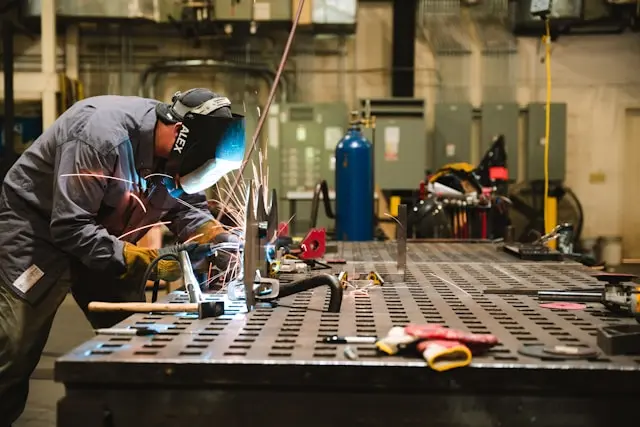
The Anchor That Shapes Everything
The split runs along a single fault line: skill intensity. SteelUp!, the modernisation of the Belval electric steelworks that will supply Rodange's rail mill with decarbonised steel and cut the carbon footprint of its products by a factor of six, is the most visible marker of an upgrade cycle running through every maintenance, machining, and fabrication role in the cluster's orbit. Electromechanical, automation and precision-machining capabilities matter more with every contract cycle — and ADEM's national shortage list has now added industrial mechanical maintenance to the professions where declared demand most clearly outruns available candidates. Meanwhile, Luxembourg's construction sector is still shedding jobs — employment fell 1.3% year-on-year in the fourth quarter of 2025 — keeping pressure on the structural steel subcontractors who once provided a reliable counterweight to steelworks dependency. The investment in upgrading the cluster's anchor employer has not reduced the need for workers. It has replaced one category of worker with another that the local and cross-border labour market cannot yet produce at the scale required.
What follows is an analysis of the forces reshaping this small but consequential industrial cluster. It covers the structural dynamics creating the talent gap, the specific roles where shortages are most acute, the cross-border labour mechanics that both sustain and constrain the workforce, and the compensation realities that hiring leaders in this market must understand before they commit to a search.
No analysis of Differdange's talent market makes sense without first understanding how completely ArcelorMittal dominates it. ArcelorMittal Long Products Luxembourg groups the Belval, Differdange and Rodange installations under a single entity employing more than 2,100 people, more than 800 of them at Differdange. The Differdange site pairs an electric steelworks with the Train Grey rolling mill — producer of the Jumbo beams, the largest in the world, rolled into some of the planet's tallest buildings — with a stated capacity of 1.35 million tonnes of crude steel a year. A second electric steelworks and two hot rolling mills operate at Esch-Belval, and the Rodange mill rolls tramway and crane rails. Around this anchor sits a supply chain of maintenance, machining and fabrication contractors that extends across three countries and shapes hiring decisions, wage expectations, and career trajectories for thousands of workers who never appear on ArcelorMittal's own payroll.
Green Steel in a Cluster That Is Already Green
The decarbonisation story here is not a story about replacing blast furnaces. Luxembourg's crude steel has been produced entirely electrically since 1997, on a scrap-based charge that is 98% recycled metal and predominantly decarbonised electricity — some of the lowest-carbon steel produced anywhere, and the reason most Made-in-Luxembourg products carry ArcelorMittal's XCarb label. The programme now reshaping the cluster is SteelUp!, the modernisation of the Belval steelworks so that it can feed Rodange's Train A rail mill with decarbonised steel, cutting the final carbon footprint of Train A products by a factor of six. At group level, ArcelorMittal plans to cut the carbon intensity of its operations by up to 10% by 2030 against 2018, on the investment decisions taken to date, with net zero by 2050 still the stated destination.
None of this removes people from the process. It rewrites the technical requirements for every maintenance, machining, and fabrication role within the cluster's orbit. A modernised steelworks chain competing on low-carbon quality demands technicians who can work across electro-mechanical systems, automation controls, and high-pressure hydraulics simultaneously. That single dynamic captures the entire market: fewer routine openings, harder technical work, higher stakes per hire.
The knock-on effect reaches every SME in the cluster. A maintenance contractor serving the mills' roll refurbishment needs cannot simply replace a retiring mechanic with a younger one. The replacement must operate in an environment that is materially more complex than the one the retiree entered. When that gap goes unfilled, the cost is not merely an HR inconvenience. It translates directly into mill downtime, overtime bills, and a progressive hollowing of the technical knowledge base that sustains industrial manufacturing operations across the region.
The Dependency Risk No One Can Diversify Away
The concentration risk is structural: one anchor employer, one cluster of contractors, one labour market. Any shift in ArcelorMittal's procurement strategy — toward centralised international maintenance providers, or in-house automation of services currently outsourced — would cascade through the SME cluster within a single contract cycle. No published municipal or sector survey quantifies the revenue dependency of Differdange-area metalworking SMEs on the anchor and its tier-one contractors. The direction of the exposure is not in dispute, and hiring leaders should read the cluster's workforce decisions against the anchor's procurement calendar rather than against diversification plans that do not yet exist.
Three Roles the Market Cannot Fill
The shortages in Differdange's metalworking cluster are not generalised. They concentrate in specific role categories, each with distinct causes and distinct consequences. The official record now confirms the pattern. ADEM's 2025 list of professions in acute shortage — compiled from declared vacancies, registered jobseekers and unmatched posts for reference year 2024 — added industrial mechanical maintenance as a new entry, while the closely related installation-and-maintenance-of-industrial-equipment trade dropped off only because the imbalance no longer met the strictest threshold; ADEM itself notes that these professions remain under tension. When a national shortage list starts churning industrial maintenance trades in and out of its tightest category, the market signal is unambiguous: demand for these skills repeatedly exceeds the candidates the public employment system can produce.
Industrial Maintenance Technicians: The Profile on the Shortage List
The tightest market is industrial maintenance: dual-certified electromechanical technicians, automation-capable electricians, and the hydraulics specialists on which the mills and their contractors depend. Industrial mechanical maintenance entering ADEM's shortage list for reference year 2024 means declared demand ran ahead of available candidates on the public register — and list status has a practical edge for employers, who can use simplified, accelerated procedures to hire third-country nationals for listed professions, with the foreign-worker certificate issued within five working days. No published series tracks how long maintenance roles in the Differdange basin stay open. That such durations run to months rather than weeks — and lengthen as the installed technology base grows more complex — is the operating assumption on which every hiring plan in the cluster should be stress-tested, and the first number any serious search partner should be asked to document.
CNC Machinists: The Housing Cost Rejection
The second critical shortage is in CNC machinists capable of programming and operating large-format equipment — roll refurbishment for the mills, precision machining for the contractors that feed them. The constraint here is geographic as much as it is technical. Luxembourg's advertised apartment rents rose 5.8% year-on-year in the second quarter of 2026, according to the housing observatory, and advertised rents on the French side of the border sit far below Luxembourg levels. For a machinist aged 30 to 45 with a family, the arithmetic of commuting versus relocating resolves decisively against Luxembourg residency. Employers who do not engineer their offers around that arithmetic keep losing candidates to the commute. Positions like these stay unfilled for months, not weeks, and the cost of a prolonged vacancy is not the overtime bill but the delayed roll refurbishment and the contract capacity a vacant machining cell represents.
EN 1090 Certified Welders: A Fixed Pool at a Rising Price
The third shortage is in welders certified for structural steelwork under EN 1090, the CE-marking framework whose execution classes scale with the consequence of structural failure — bridges and comparable structures sit in the highest classes. Certification demands both welding skill and quality-management discipline, and the population of certified welders in the Differdange-Esch basin is finite. In a market like that, every premium a firm pays moves a person between employers rather than adding capability to the region: the same names circulate at rising cost while the certification pipeline adds new welders slowly. For buyers of fabrication capacity, the practical consequence is longer lead times and thinner certified capacity at peak. For employers, it is that retaining a certified welder is now cheaper than any replacement strategy.
The Cross-Border Labour Machine and Its Vulnerabilities
Differdange's metalworking sector does not operate as a Luxembourg labour market. It operates as a Saar-Lor-Lux labour market. Luxembourg counted 238,396 cross-border workers at the end of March 2026, and residents of France form the largest contingent by a wide margin — 126,600 of them in the 2025 social-security statistics — with smaller contingents commuting from Belgium and Germany. The road and rail corridors that carry this workforce across the French border each morning are, in practice, production infrastructure for the cluster. Any sustained disruption to them creates an immediate staffing problem for every employer in the basin. This is not a theoretical concern. It is a recurring operational reality that shapes shift scheduling and contingency planning.
The Compensation Paradox for Cross-Border Workers
Cross-border employment changes the arithmetic of every offer. A French-resident worker's net position depends on the cross-border tax and social-security arrangements between the two states, on commuting costs, and on housing costs measured in France rather than Luxembourg. Luxembourg gross salaries for metalworking roles run visibly above equivalent positions across the border, but the effective premium to a commuter is only what survives that arithmetic — which is why recruiters who present offers in net take-home terms convert candidates that gross-range postings lose. The pattern has a corollary for relocation: when a candidate would have to move into Luxembourg rather than commute, the rent differential between the two sides of the border eliminates most of what a gross salary advantage appears to offer.
Compensation That Tells the Real Story
Executive and senior specialist compensation in Differdange's metalworking sector reflects the tension between industrial margins and the scarcity premiums the market demands. It also reflects a benchmarking gap: no published, role-specific salary benchmark for senior maintenance, production and CNC-specialist roles in Luxembourg's industrial sector could be located in this market's public sources — the international salary guides that cover Luxembourg publish primarily for finance, IT and consulting. What can be stated with confidence is the structure. Base salaries carry shift and overtime premia. Management bonuses tie to contract retention and safety. Cross-border candidates negotiate from a net-purchasing-power position rather than a gross-figure one. And the scarcity premium rises precisely because the certified, multi-disciplinary profile a modernised mill chain demands is the profile the regional labour market reproduces most slowly.
This is the synthesis this analysis demands: the cluster's upgrade cycle requires exactly the category of digitally literate, multi-disciplinary technician that Luxembourg's financial and data-centre economy is simultaneously recruiting. The competition for this talent is not between Differdange metalworking firms and their French or German counterparts. It is between Differdange metalworking firms and the office economy of Luxembourg City. The losing side is heavy industry, and the gap is widening at exactly the skill level where the cluster's upgrade cycle needs it most.
The Regulatory Squeeze on Small Employers
Two regulatory frameworks shape the operating environment for SMEs in the cluster — one arriving in 2026, one permanently in force.
CBAM: An Importer Mechanism That Still Reaches the Cluster
The EU's Carbon Border Adjustment Mechanism enters its definitive regime on 1 January 2026. Its obligations attach to importers of covered goods — cement, iron and steel, aluminium, fertilisers, electricity and hydrogen — in the form of authorisation, reporting, and the purchase and surrender of CBAM certificates priced off the EU emissions trading system. A Luxembourg fabricator buying European steel faces no direct CBAM filing duty; the mechanism is not a paperwork obligation on downstream manufacturers. It still reaches the cluster economically. CBAM raises the price of high-carbon imported steel relative to European production, reinforcing the competitive position of the low-carbon, XCarb-labelled mills around which this cluster is built, while fabricators with direct import exposure need to treat CBAM administration as a compliance line-item from 2026. For hiring leaders the signal is indirect but real: the cluster's competitiveness story strengthens around certified low-carbon production, and the premium skills that keep those mills running rise in value with it.
EN 1090: The Permanent Cost of Staying Certified
Structural steelwork in the EU moves under the EN 1090 CE-marking framework, which requires certified factory production control — audited processes, documented welding procedures, certified personnel. That framework is a permanent fixed cost of remaining in the structural market, and one reason certified fabrication capacity concentrates among the firms that can carry the compliance load. For executive recruitment in this sector, the implication is that hiring leaders at these surviving firms carry disproportionate operational responsibility and command correspondingly higher retention premiums.
What This Means for Hiring Leaders in the Cluster
The market dynamics outlined above create a specific set of conditions that any organisation hiring in Differdange's metalworking sector must account for.
First, the candidate pool for senior maintenance engineers and CNC programming specialists is overwhelmingly passive. No public register lists them: ADEM's shortage-list mechanics establish that declared demand exceeds the candidates the public system can refer, not where the people are. At the executive and senior specialist level, candidates must be identified and approached directly. Job advertising will not reach them. A conventional recruitment process that begins with a posting and waits for applications will produce a shortlist drawn from the segment of the market that is actively looking — not the segment that can actually do the work.
Second, cross-border compensation dynamics require a level of offer engineering that most industrial employers are not accustomed to providing. The effective value of an offer to a French-resident commuter is not the gross figure on the contract. It is the net take-home after the cross-border tax and social-security arrangements, commuting costs, and the housing comparison between the two sides of the border. Employers who fail to present offers in these terms keep losing candidates whose offers looked, on paper, unbeatable.
Third, the timeline for filling a critical role in this market is measured in months, not weeks — and because no public series publishes vacancy durations for this niche, every employer should ask a search partner to document its own record on time-to-shortlist. The counteroffer risk when a passive candidate is identified and engaged is substantial, given that current employers facing the same shortages have every incentive to retain.
Start a conversation with our industrial sector search team about how we approach the Greater Region talent pool.
The 2026 Outlook: Selective Contraction, Selective Intensity
Three trajectories define 2026 for this cluster, all of them verifiable in the public record. The Belval steelworks is being modernised under SteelUp! to feed Rodange's rail mill with decarbonised steel — the flagship investment actually under way in Luxembourg steel. Luxembourg's construction sector is still contracting, with employment down 1.3% year-on-year in the fourth quarter of 2025, keeping pressure on the fabrication firms dependent on building work. And industrial mechanical maintenance now sits on ADEM's national shortage list for reference year 2024, with the adjacent industrial-equipment trades explicitly still under tension. The firms that survive the next two years will be those that can hold their technical workforce together through the construction slowdown while positioning for the maintenance, automation and precision-machining work that a modernised, low-carbon mill chain generates.
For hiring leaders, the implication is direct. The window to secure senior technical talent in this market is not closing because demand is falling. It is closing because the firms that act now will lock in the specialists they need before the next phase of the cluster's upgrade cycle raises demand further. The firms that wait will find themselves competing for the same candidates at higher cost, in a market where every competitor has already learned that traditional recruitment methods do not work.
The Differdange metalworking cluster is small, concentrated, and deeply technical. It is also a market where the difference between a firm that has its senior maintenance engineer in place and one that does not is measured in mill downtime, lost contracts, and a competitive disadvantage that compounds with every month of vacancy. The investment in decarbonised steel has not reduced the need for human expertise. It has raised the bar for what that expertise must include. The firms and search partners who understand this will define the next chapter of this cluster's industrial story.
Frequently Asked Questions
What are the hardest metalworking roles to fill in Differdange, Luxembourg?
The most difficult roles to fill are industrial maintenance technicians with dual electro-mechanical certification, large-format CNC machinists specialising in roll refurbishment and precision work, and EN 1090-certified structural welders. Industrial mechanical maintenance now sits on ADEM's national shortage list for reference year 2024 — the list of professions for which declared vacancies repeatedly exceeded available registered candidates. The shortage reflects a passive candidate market, a construction downturn that keeps fabricators competing for the same technical profiles, and housing cost differentials that deter relocation from neighbouring France and Germany.
What do senior metalworking executives earn in Luxembourg?
No published, role-specific salary benchmark for senior maintenance, production or CNC-specialist roles in Luxembourg's industrial sector could be located in this market's public sources; the international guides covering Luxembourg concentrate on finance, IT and consulting. What is verifiable is the structure: base salaries carry shift and overtime premia, management bonuses tie to contract retention and safety performance, and French-resident cross-border candidates negotiate against net purchasing power rather than gross figures. Role-specific compensation intelligence for this cluster is available through KiTalent's market benchmarking service.
Why do offers to CNC machinists in Luxembourg fail?
Offers to Greater Region candidates frequently fail on housing arithmetic rather than on the salary level itself. Luxembourg's advertised apartment rents rose 5.8% year-on-year in the second quarter of 2026, according to the housing observatory, and advertised rents on the French side of the border sit far below Luxembourg levels. Once commuting costs and cross-border tax arrangements are factored in, a gross premium that looks decisive can shrink to very little — and a candidate who would have to relocate into Luxembourg loses most of it to the rent differential. Employers who present offers in net take-home terms reduce this risk materially.
How does ArcelorMittal's green steel transition affect hiring in Differdange?
Luxembourg's steel has been produced entirely in electric arc furnaces since 1997, on a 98% recycled charge — the transition here is an upgrade of an already low-carbon base, not a blast-furnace replacement. The current flagship project is SteelUp!, the modernisation of the Belval steelworks to feed Rodange's rail mill with decarbonised steel, cutting the carbon footprint of Train A products by a factor of six. The hiring effect is a rising requirement for automation and multi-disciplinary electro-mechanical skills across the mills and their suppliers: fewer routine openings, materially higher skill requirements for each one. SMEs in the supply chain must upgrade workforce capabilities to retain contracts.
How does KiTalent approach executive search in niche industrial markets like Differdange?
In the Differdange metalworking cluster, this means mapping senior maintenance engineers, production directors, and CNC specialists across the Saar-Lor-Lux Greater Region, including French and German candidates who would not respond to conventional job postings.
What regulatory pressures affect metalworking SMEs in Luxembourg in 2026?
Two frameworks shape 2026. The EU Carbon Border Adjustment Mechanism enters its definitive regime on 1 January 2026: its authorisation, reporting and certificate obligations attach to importers of covered goods — iron and steel among them — while downstream fabricators buying European steel face no direct filing duty, but see carbon priced into the imported-steel market. The EN 1090 CE-marking framework for structural steelwork remains a permanent compliance requirement built on certified factory production control. Together they reward firms that can carry the compliance load and certified, low-carbon production — and thin the field for those that cannot.
Related Links
- Differdange
- Luxembourg
- Wiltz Renewable Energy Talent: What the Verified Record Shows
- Dudelange Logistics Hiring: Why Zero Warehouse Space and a Shrinking Talent Pool Are Forcing a New Operating Model
- Wiltz Tourism Hiring: Define the Mandate Before the Search
- Milan Fashion Hiring: Separate Brand, Industrial and Supply-Chain Leadership
Related Market Reads
Articles tied to the same hiring geography or market context.
Wiltz Renewable Energy Talent: What the Verified Record Shows
The verified public record for Wiltz - a 764-documented Ardennes town of 6,145 on the river of the same name, battle-scarred and castle-crowned - and what a renewable-energy mandate in Luxembourg's north must actually cover.
Dudelange Logistics Hiring: Why Zero Warehouse Space and a Shrinking Talent Pool Are Forcing a New Operating Model
Dudelange's Zone Industrielle is running at 98% warehouse utilisation with no Class A logistics space available. Average rents for modern logistics facilities climbed 12% year...
Wiltz Tourism Hiring: Define the Mandate Before the Search
What the verified public record establishes about Wiltz - its 1727 castle, 6,145-strong town population and Battle of the Bulge heritage - and where a tourism mandate needs contacted, assessed and validated candidates.
Nearby Market Signals
Lateral reads from adjacent cities, sectors, or themes.
Milan Fashion Hiring: Separate Brand, Industrial and Supply-Chain Leadership
How should a Milan fashion mandate distinguish brand-headquarters leadership from industrial and supply-chain capability?
Valencia Hospitality Volume: Define the Mandate Before Mapping
For a Valencia Hospitality Volume mandate, begin with the property, portfolio, guest segment and service model.
Vaasa Power Electronics Talent: What the Verified Record Shows
The verified public record for Vaasa - the bilingual Ostrobothnian capital whose national-scale power infrastructure and multi-institution campus anchor Finland's west-coast energy-technology economy - and what a power-electronics mandate there must actually cover.
From the Archive
Evergreen background reading that still sharpens current hiring decisions.
Wiltz Light Manufacturing: Why 112-Day Vacancies Are Rewriting the Rules for Luxembourg's Northern SMEs
Wiltz is a commune of 7,600 people in Luxembourg's rural Éislek region. It maintains 35 hectares of zoned industrial land, two active industrial zones with occupancy above 94%,...
Luxembourg Fund Servicing Talent: What the Verified Record Shows
The verified public record for Luxembourg's fund industry - the world's second-largest investment fund centre under CSSF supervision - and what a fund-servicing leadership mandate there must actually cover.
Luxembourg Legal and Fund Governance Hiring: Define the Mandate Before the Search
What the verified public record establishes about Luxembourg's fund-centre standing, its EU-institutional seat, and where a legal or governance mandate needs contacted, assessed and validated candidates.